Open and Look
The grate or lid comes off and the crew sees how far the sump has loaded, what is in it, and whether anything about the structure itself needs flagging.

A catch basin is a trap. It works by holding grit and debris so they never reach the pipe, and it stops working the moment it is full.
Send a scope and we will price it. Drawings welcome.
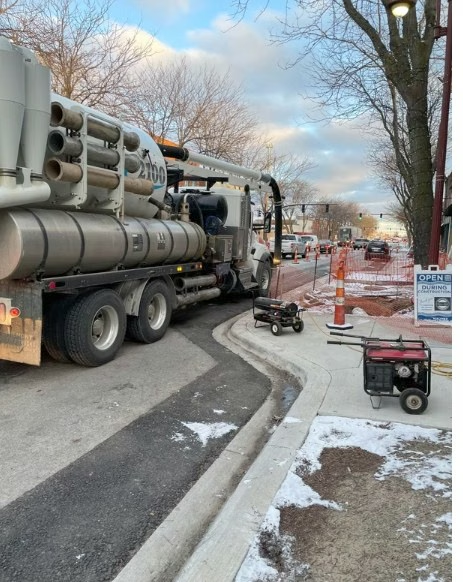
Once a basin has silted up to the level of the outlet, everything it was meant to catch goes straight into the storm system. The structure is still there, still looks fine from the surface, and is doing nothing.
That is the argument for cleaning basins on a cycle. A basin is a small, accessible structure that a truck can empty in a short visit. The mains it was protecting are neither, and neither is the flooding that follows when they silt up.
It is also the reason a visual check from the grate is not much use. A basin at capacity and a basin with room in it look much the same from above.
The grate or lid comes off and the crew sees how far the sump has loaded, what is in it, and whether anything about the structure itself needs flagging.
Material is lifted out with the Jet-Vac, down to the sump rather than skimmed off the top, because a half-emptied basin fills back to the outlet quickly.
The outlet is checked to confirm the basin drains, and the load leaves with the truck for disposal.
On a municipal inventory the work usually pairs with storm sewer cleaning, since the structures and the line they feed are the same system and it is one mobilization rather than two.
What sits in a sump is road grit, sand and salt, leaf litter, sediment washed off whatever is upstream, and the general run of what ends up on a road surface. It is not clean fill and it is not something to leave beside the structure.
The load leaves with the truck and goes for disposal through the correct channels. If your specification calls for documentation of what was removed and where it went, say so with the scope and we will confirm what we can provide before the work is priced.
Emptying a basin restores the trap. It does not change the structure or what is reaching it.
We have cleaned Ohio drainage structures since 1960, out of Clyde, with our own fleet and our own crews. Basins, the lines they feed, inspection and the disposal that follows are all in house.
Municipalities, property managers and contractors. Quotes turned around quickly.