Trace the Line
A transmitter or sonde sends a detectable signal from inside the sewer or drain line.

A transmitter or sonde goes into the line and a receiver follows the signal from the surface, so the route can be traced and marked on the ground. Where the equipment and site conditions allow, an estimated depth can be marked too.
Not urgent? Request service online and we will call you back.
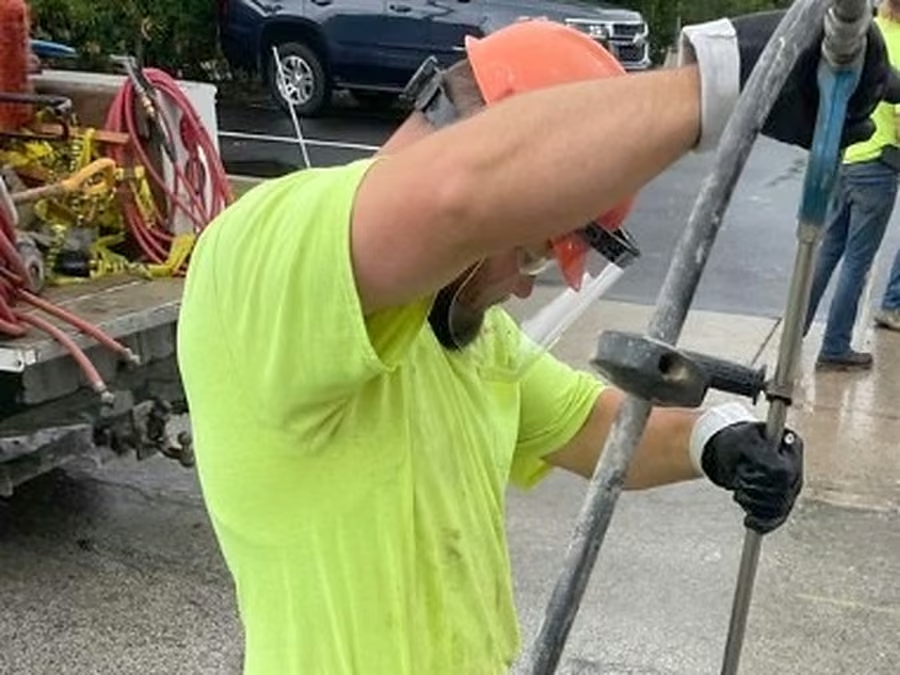
Plenty of properties have no reliable record of where anything runs. The tank lid is under sod, the lateral takes a turn nobody remembers, the plans were lost two owners ago, and the only way to find out has traditionally been to start digging.
Electronic locating identifies the route from the surface, so crews can plan targeted excavation instead of opening exploratory holes to find the line. That matters as much on a commercial parking lot or a municipal easement as it does on a lawn.
A transmitter or sonde sends a detectable signal from inside the sewer or drain line.
A receiver follows that signal above ground to identify the route the line takes.
The route is marked on the surface, along with an estimated depth where the equipment and conditions allow, so inspection, excavation or repair can be planned around it.
Find a buried tank, lid or access point before a cleaning, inspection or service call, rather than probing the yard for it.
Trace the path a private sewer or drain line actually takes across a property, including the turns that are not on any drawing.
Pair locating with TV sewer inspection to work out where, on the surface, a problem found inside the line sits.
Identify the route of a known line before excavation, landscaping or construction, so the dig is planned around it. On congested sites this pairs with hydrovac excavation.
Help determine the route of a sewer lateral and where a private line meets the main, which is often the point a responsibility question turns on.
Give a crew better information about where targeted excavation is likely to be needed, before anyone commits to opening ground.
These two answer different questions, and most jobs need both.
A camera inspection tells you what is happening inside the line: a blockage, a break, root intrusion at a joint, a connection nobody knew about, or a change in the condition of the pipe. What it does not tell you is where that point sits from above.
Electronic locating answers the where. Run together, the camera finds the fault and the locator helps identify the corresponding position on the surface, so the next step can be planned around real information. Not every fault can be pinpointed exactly, and ground conditions and pipe material both affect how well a signal reads, but it is a great deal better than measuring from the wall and hoping.
We have been tracing and working buried sewer and septic lines in Ohio since 1960, out of Clyde, with our own crews and our own equipment. Locating is rarely a job on its own: it usually sits alongside a cleaning, an inspection or a dig, and we run all of those too.
Routine or urgent. Someone who knows the work answers the phone, day or night.