Work the Structures First
Catch basins and inlets hold most of the grit, and clearing them first keeps what is in them from washing into the line the moment it rains.

Storm systems fail on the worst possible day, because that is the day they are asked to work. Grit, leaf litter and construction debris accumulate quietly and then matter all at once.
Send a scope and we will price it. Drawings welcome.
The cost of a blocked storm system is rarely the cleaning. It is the flooded parking lot, the basement, the road closure and the complaints. Cleaning before the season is the cheap end of that.
On a commercial site it is also a liability question. Standing water where it should not be tends to become somebody's claim.
Storm work has a season to it in Ohio. Grit and salt from the winter, then leaf litter in the fall, and construction debris whenever there is work upstream. Most sites are better served by a route run at the right point in the year than by a callout after the first storm that finds the problem.
Catch basins and inlets hold most of the grit, and clearing them first keeps what is in them from washing into the line the moment it rains.
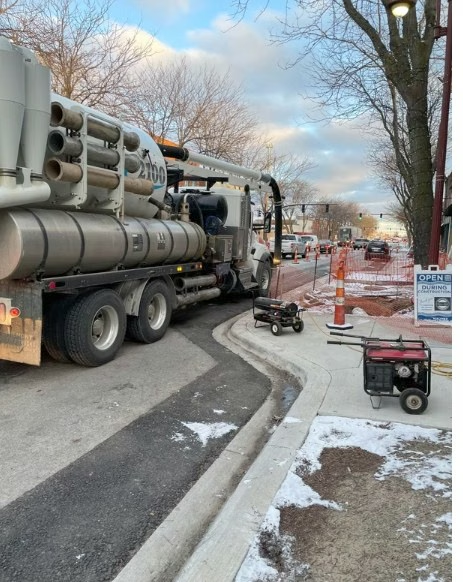
Structure to structure with the Jet-Vac, so silt and debris are lifted out rather than pushed toward the outfall.
The load leaves with the truck. Catch basin grit is not clean fill, and it is not something to leave bagged at the curb for somebody else.
Work is done with the Jet-Vac, so what comes out leaves with us. Where a line will not stay clear, a camera is usually a better next step than another cleaning.
They get treated as one job and they are not. A storm system is built to move water fast, in volume, on the few days a year it matters, and what fills it up is mostly what the surface hands it: grit, salt, leaves, sediment and whatever a site upstream has been washing off.
That has two practical consequences. The structures do more of the work than the pipe does, which is why catch basins are where a storm program earns its money. And a cross connection between the two systems is worth finding, because stormwater in a sanitary sewer is capacity nobody planned for. Smoke testing is how those get located.
Cleaning restores what silt and debris took away. It does not change what the system was built to carry.
We have cleaned Ohio storm systems since 1960, out of Clyde, with our own fleet and our own crews. Structures, lines, inspection and the disposal that follows are all in house.
Municipalities, property managers and contractors. Quotes turned around quickly.