Get Into the Line
The hose goes in through an existing access point: a cleanout, a manhole, a septic tank or, where there is no other way in, a pulled fixture.

A jetter puts water down the line at pressure, cuts the build-up off the pipe wall and flushes it away. Where the pipe itself is sound, that is the difference between poking a hole through a blockage and getting the line back to its full diameter.
Not urgent? Request service online and we will call you back.
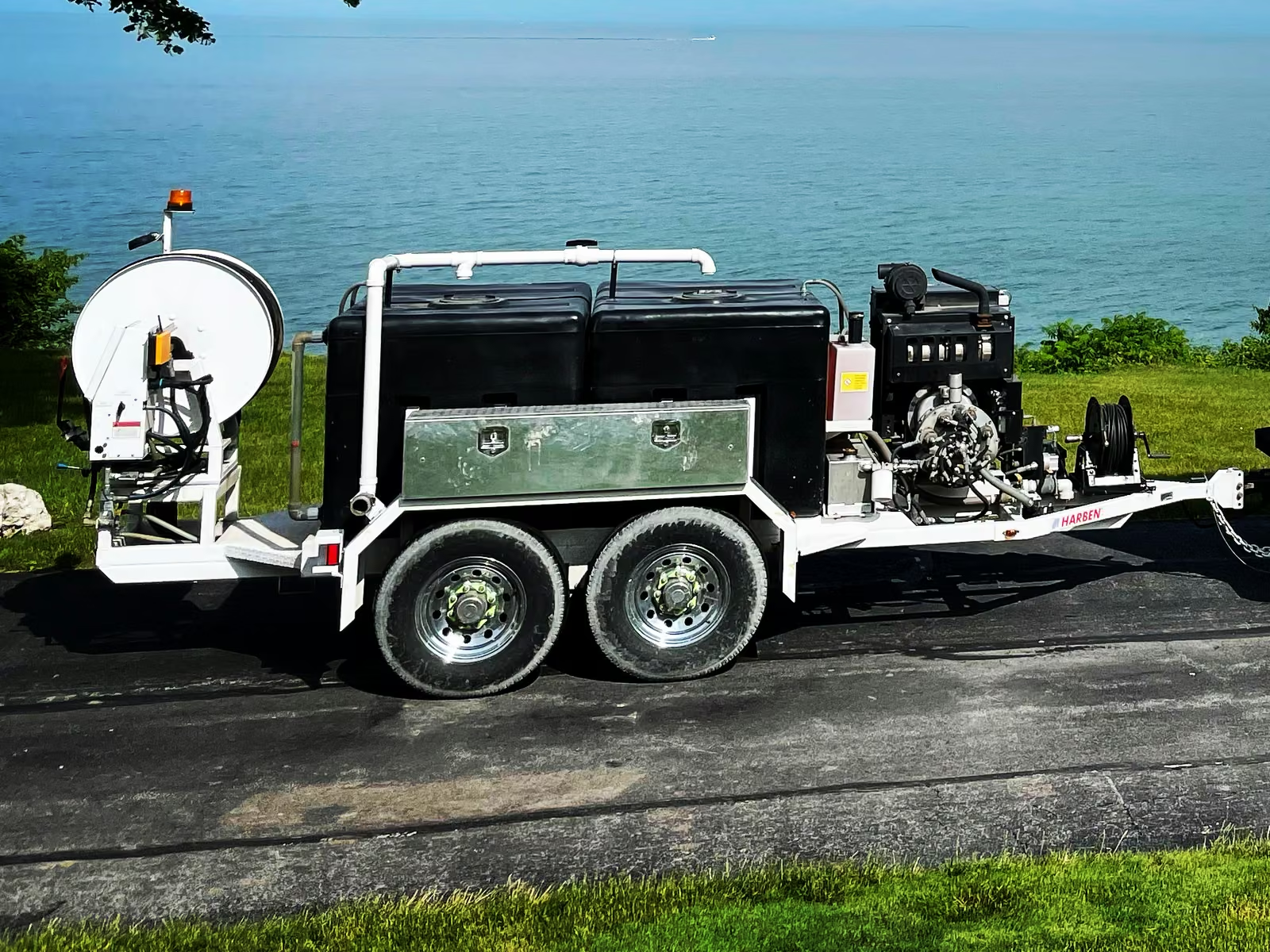
Grease is the usual culprit in a kitchen line, and a cable does not do much about it. A snake bores a hole through the middle and leaves the rest sitting on the pipe wall, so the line closes up again. Water at pressure strips it off.
The same goes for sludge and scale in an older line, and for fine root hair that has worked in through a joint. For heavier root intrusion we would normally camera the line first, and often follow the jetting with RootX, because cutting roots without treating them just sets the clock running again.
The hose goes in through an existing access point: a cleanout, a manhole, a septic tank or, where there is no other way in, a pulled fixture.
The nozzle feeds up the line and water at pressure cuts the build-up away from the pipe wall, rather than boring a channel through the middle of it.
The debris is carried back down to the access point and cleared. On larger scopes the Jet-Vac vacuums it up in the same visit, so it leaves the site with us.
On a larger scope the work is usually done with the Jet-Vac, which jets and vacuums in one visit so the debris leaves site with us rather than settling further down the system.
Jetting cleans a line. It does not repair one, and it is worth being clear about the difference before you spend money on it.
If we get there and the problem turns out to be structural, we will tell you that rather than jet it and book you in again in three months.
Where it matters, we can put a camera down afterwards so you can see the pipe wall rather than take our word for it. On a recurring problem that is worth doing, because it shows whether you are dealing with build-up that keeps coming back or with something structural underneath it.
It is the same reasoning that puts a camera in before the jetting on a line nobody has looked at. Cleaning a line you have seen is a different job from cleaning one you have not.
We have been clearing sewer and drain lines in this part of Ohio since 1960, with our own jetting equipment and our own crews. Jetting is rarely the whole job: it usually sits alongside an inspection, a locate or a septic service, and we run all of those ourselves.
Routine or urgent. Someone who knows the work answers the phone, day or night.